
Mediating the Summer Olympic Games Opening Ceremonies
Every four years, the Summer Olympic Games brings together over 200 countries to celebrate the highest levels of athleticism on the world stage. Throughout the twentieth and twenty-first centuries, viewers have turned on televisions (or, as of recently, logged onto streaming platforms) to see athletic feats, individual and collective triumphs, and geopolitical battles manifest in the sporting arena. Niche sports such as fencing, water polo, and dressage become discursive battlegrounds within households and social media. There, viewers contrive and subscribe to narratives about individual athletes, national teams, and global tensions. While audiences’ investment in specific athletes and sports may change from year to year, one carefully constructed element of the Games stays the same, courtesy of the International Olympic Committee (IOC): the opening and closing ceremonies. The opening ceremony is one of the most-viewed Olympic events. It is also highly regulated. While the Olympic charter, the primary governing document for all Olympic events, does not detail many specifics concerning opening ceremonies, the IOC’s contracts for Olympic host countries and the Olympic Games Guide on Ceremonies (cited in every host’s contract) point to an exceedingly regimented event. The host city’s national anthem, official speeches/openings, the parade of athletes, the lighting of the Olympic flame, and the artistic program are just some elements that must be included during the opening ceremony.
Additionally, the IOC has asserted that, like all events sponsored by the Olympics, the opening ceremony must be free of political propaganda. Since the middle of the twentieth century, the IOC has practiced political neutrality, a catchall phrase that originally meant that the IOC would be an autonomously run, independent organization free from political interference. Crucially, this phrase has been critiqued by scholars spanning many disciplines because of the IOC’s fluid interpretation of the rule. As the organization writes in its charter, “sport occurs within the framework of society,” and try as they might (or might not), countries, cities, and organizers come to the metaphorical table with historical and sociocultural goals far beyond the reach of the Olympic committee. Further, increased televisual participation from audiences has allowed the creators of the opening ceremonies to broadcast messaging about the state of global affairs to international audiences. The opening provides an opportunity every four years for viewers to engage in a mediated experience unlike any other international event. Considering the political stakes at play for the ceremonies’ creative architects, how might we as audience members engage critically with the ceremonies?
This essay elucidates the sonic relationship between producers (host cities and the IOC) and consumers (at-home spectators) during the opening ceremonies of the Summer Olympic Games. By developing two case studies around recent Games—Rio 2016 and Paris 2024—I show how sound and music at Olympic openings are deployed by producers to help consumers engage both national and global histories. At the end of this article, I suggest some ways that we, as viewers, can engage with televisual communication circuits to better understand both our active and passive involvement in shaping national narratives.
The Paris 2024 Artistic Program
Within the framework of the opening ceremonies, host cities quite literally produce a media event as critical space. Since the Moscow 1980 Summer Olympics, it has been the goal of the host city (standing in for the host country) to explicitly articulate its past, present, and future through large-scale spectacle. The creative teams selected and employed by Olympic hosts are tasked with producing mini-narratives related to the origin of the host city, holistically conceived. Though there are consistent elements in each opening ceremony, every host city’s unique realization of these features obscures the IOC’s standardization. The differences within the constraints of the opening ceremonies contribute to tensions in mediation for live and television audiences.
The artistic program of any opening ceremony is a compelling location for long-form storytelling. Past artistic programs, specifically before Barcelona 1992, did not attempt storytelling at all. Instead, these productions (e.g. Moscow 1980, Los Angeles 1984) were primarily concerned with large sets and big groups of people. Committees continue to emphasize this large scale, but narrative has grown increasingly important, with organizers hiring film directors to craft opening and closing ceremonies that combine spectacle with persuasive storytelling. The program now exclusively features a linear, narrative format, often drawing on national myths and symbols to appeal to global audience members.
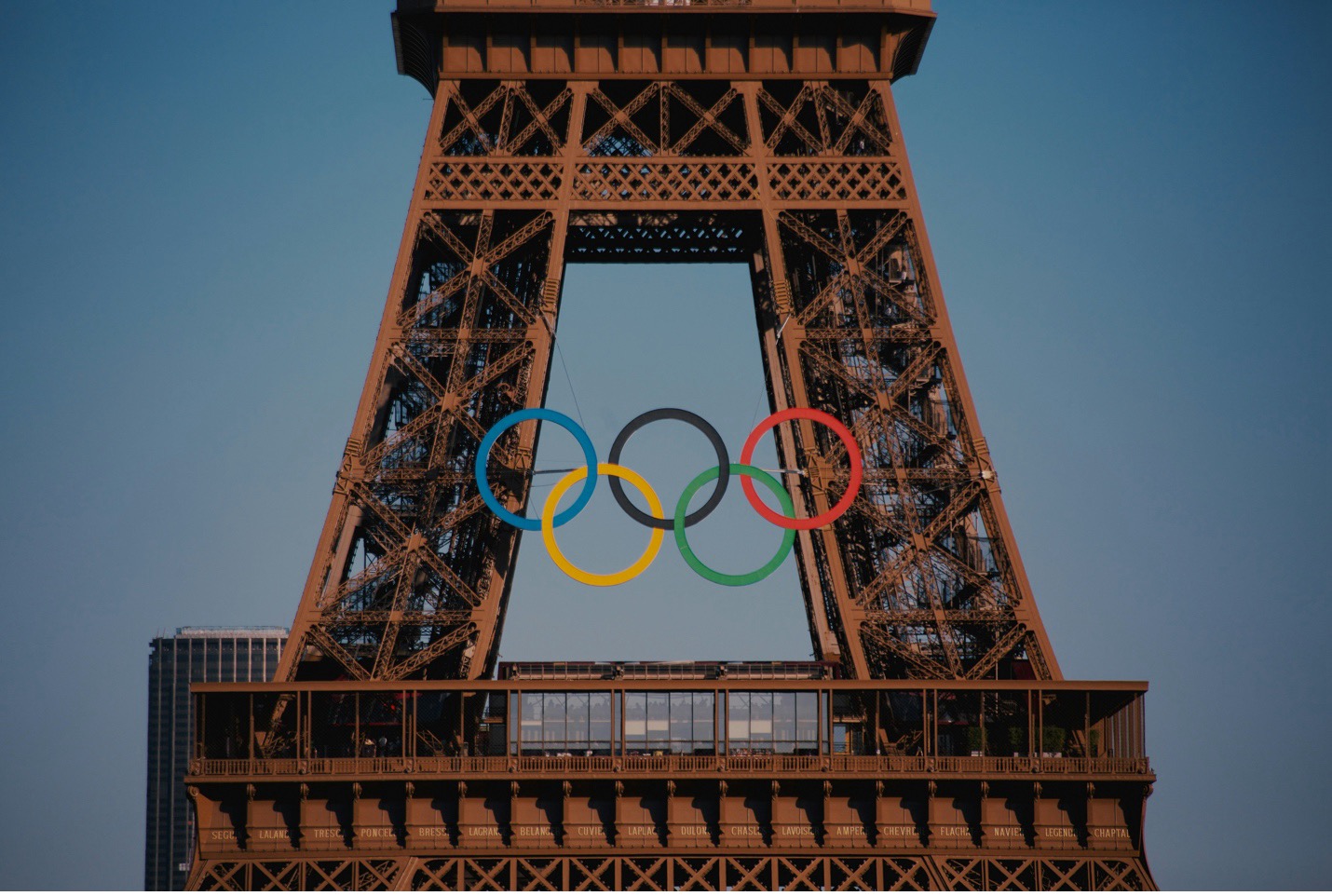
Most recently, this format was on display at the Paris 2024 Olympics. Using twelve thematic “tableaux,” Paris’s artistic program referenced the city’s historical past through music, dance, and image. Viewers were treated to scenes from famed Parisian historical sites like the Moulin Rouge, the Théâtre du Châtelet, and the Conciergerie. The music was connected to each location by both literal and “imagined” geographical association, drawing on the mythos constructed by artistic director Thomas Jolly and his collaborators to produce an almost utopian “ideal” of Paris. Even though referenced parts of the ceremony may not have occurred in their exact location, viewers were intended to imagine themselves as part of the historical moment. For example, in a section dedicated to the history of the Moulin Rouge, artists from the revue performed a can-can, a dance of French origin that is historically and culturally significant due to its feminist origins, athleticism, and proliferation in cabarets throughout the world. However, these dancers were on the Seine instead of inside the Moulin Rouge so that they could be seen by the passing delegations on boats. In another section staged outside of the Conciergerie, the prison that housed former Queen of France Marie Antoinette, vocalists sang the French revolutionary song “Ah, Ça Ira” while dressed as the beheaded queen. The scene directly alluded to the French Revolution, invoking what the Paris Olympic Organizing Committee referred to as “political and personal emancipation.”
Many of the Paris tableaux, including the ones mentioned above, prompted discussion on media outlets globally. Perhaps the most notable instance of dialogue concerned the eighth tableau of the program, titled “Festivity,” which featured both drag artists and dancers of myriad styles including ballroom, breaking, and modern dance celebrating around a banquet table. The tableau faced criticism from conservative news outlets and viewers who claimed that the scene resembled The Last Supper and was an attempt at mocking Christianity. (The Paris Olympic Organizing Committee later clarified that the reference was not related to Christian iconography as represented in Leonardo Da Vinci’s The Last Supper, but rather Jan van Bijlert’s The Feast of the Gods. Conservative pushback included, Paris’s artistic program was in line with its predecessors. Its conceptualization of the city as a cosmopolitan center of intelligence, art, and freedom (widely construed) is one way that cities may choose to recognize their historical past using music and moving image.
Sound and Historical Reckoning at the Olympics
Sound at the Olympics can also be used by host cities in attempts to repair historical injustices, though most host cities have chosen to avoid acknowledging histories of racism, violence, imperialism, and colonialism on the Olympic stage. France, in particular, has attempted to reckon with its cultural past through subsumption of racial, ethnic, and religious backgrounds, emphasizing a predominantly French identity rather than addressing the history and effects of colonial rule and empire on its citizenry. Take, for instance, the “Equality” tableaux, which featured a performance by French-Malian singer Aya Nakamura. The Paris media guide for “Equality” deemed it a celebration of “the French language,” writing that “while it has imposed itself on many communities around the world…[French] is a bridge between people and eras.” Such a statement, while referencing the global and colonial specter of French as both official language and lingua franca, presumed a level of accepted cultural subsumption that proved to be somewhat of an illusion. In the days leading up to Paris 2024, Nakamura faced racist and nationalist attacks on social media by French far-right groups and supporters, including National Rally party leader Marine Le Pen. Nakamura herself, the Paris Organizing Committee, and French president Emmanuel Macron all mentioned Nakamura being the highest-streamed Francophone artist in the world. Nakamura’s musical choice to lyrically blend French with Arabic and Bambara, while evocative for many listeners, became racially coded and weaponized rather than the picture of unification intended by organizers.
On the other hand, the Rio 2016 Rio Olympic Games tried their hand at a more blatant acknowledgement of injustice by recreating the kidnapping and subsequent forced enslavement of West African and Bantu peoples in and by Brazil during their opening ceremony. This section of their larger opening performance produced conversation inside and outside Brazil on news outlets and social media platforms. During a section of the artistic program titled “Arrival of the Africans,” dancers of African descent moved on large, wheeled platforms or held bulky stick-like objects, which according to the Rio 2016 media guide represented “plows, the weights on the feet, shackles.” As they moved, a foreboding three-note musical motif was mixed with the sounds of chains and a periodic, loud cracking sound that suggested a whip crack. In the days following the ceremony, English-language articles from around the world largely mentioned the moment in summative sentences, quickly moving away from the choreographed scene to flashier parts of the ceremony.
Some viewers felt that Rio’s recognition was neither apology nor reparation. No other host city in the history of the Olympics Games has explicitly acknowledged their social and political atrocities in the opening ceremony program. Yet, at the time of the Games in 2016, the country of Brazil had not formally apologized for their role in the slave trade, nor had any serious talks of reparations commenced. (In 2023 and 2024, the Bank of Brazil formally apologized for the slave trade and began listening to talks of reparations.) As a viewer, I myself question how the preferred reading of this moment interacts with, to gesture to Sara Ahmed, shame. Is demonstration alone sufficient, or does the work of nation-building demand a more active engagement with a shameful past?
What is the Project of the Olympics?
The opening ceremony of the Olympic Games is full of pageantry and spectacle. But pageantry and spectacle do not exist in a vacuum for viewers. These ceremonies live long past the life of the Games, lingering in our memories and building our ideas of country, ideology, and, certainly, self. As the games move forward, how can we work to comprehend the ways in which our emotions and social beliefs are at stake in these mediated performances? What relationships are in play (between host cities, commentators, friends, and family) that shape our thoughts about nationhood? How does sound (or a lack thereof) draw attention to people and histories that have been erased or elevated through the circulation of power? And how do organizers (the IOC and host cities) use the perceived neutrality of the Games to help further the business of the Olympics? By taking the kinds of critical stances on artistic program production I’ve outlined in this piece, I encourage viewers to meet the producers’ messages with their own informed interpretations of their significance.
Digital Object Identifier: https://doi.org/10.63473/WXDQ5690