

Listening for Foremothers in Rosalía’s Lux
From polemical reworkings of flamenco idioms and the 13th-century Occitan romance Flamenca in El mal querer (2018) to feminine interventions in the Caribbean-flavored musical eclecticism of Motomami (2022), Catalan-born Rosalía Vila Tobella knows how to make a splash. Her fourth studio album, Lux, raises those stakes considerably. After a cunning media campaign that culminated in a billboard takeover in Madrid’s Gran Vía, Rosalía released the project in November 2025. With more than 42 million streams in just twenty-four hours, the drop broke the online playback record for any female Spanish-language artist in a single day. Riding that momentum, in March 2026 the singer embarked on a six-month, nearly sold-out tour with stops in Europe and North and South America.
Without a doubt, Lux’s musical and linguistic cornucopia is a feast for the ears. Channeling the genre-bending ambition of Björk and featuring arrangements by Caroline Shaw, Lux blends Rosalía’s flamenco roots with experimental pop, electronic textures, and art music, including operatic singing and accompaniment by the London Symphony Orchestra conducted by Icelandic composer Daníel Bjarnason. Within this musical summa, flamenco is the unifying idiom. This Andalusian-Romani musical tradition encompasses cante (song), baile (dance), and toque (guitar), all with an improvisatory feel and conversational intersection. It is organized around a system of distinct forms (palos), each with a characteristic compás (rhythmic cycle), tonal-modal inflection, and expressive register. Lux features eighteen songs divided into four movements, an evocation of Western art music that structurally marks the album’s narrative divisions. Together, the pieces give voice to the lyric narrator’s spiritual journey in thirteen languages, guiding listeners from worldly attachments to sacred love toward a final destination: transcendence.
As El País’s Joaquín García declared, “Nunmania is here.” Indeed, whether it is the likeness of a habit-clad Rosalía on commercially-produced Santa Clara egg-yolk sweets, British artist M.I.A’s controversial social media reaction, or young women everywhere imitating the singer’s nun-inspired Lux wardrobe on Instagram, the album’s broader cultural influence is indisputable. What’s more, traction surrounding the release of Rosalía’s opus moniale crystallized at the same time that Spanish cinematographer Alauda Ruis de Azúa premiered Los domingos, an award-winning film about a young woman choosing between the university or religious life.
Also during this period, scholars Ana Garriga and Carmen Urbita released their self-help-flavored popular take on early modern convent culture Convent Wisdom: How Sixteenth-Century Nuns Could Save Your Twenty-First Century Life, a project that grew out of the wildly popular Spanish-language podcast Las hijas de Felipe. Like Lux, Las hijas de Felipe contributes to “nunmania,” reframing the lives and cultural production of cloistered women from the early modern Spanish-speaking world as a secular template for female solidarity and patriarchal resistance for the TikTok generation. As Garriga and Urbita affirm in the episode “Nuns, Money and TikTok”: “St. Teresa can help us to manage our Tinder dates.” Propelled by social media, interlocutors like these are recontextualizing nuns of the past as foremothers—feminine guides who “mother” spiritual daughters beyond the convent by modeling woman-centered ways of living.
As a scholar of music in early modern women’s convents from the Hispanic world, it is hard for me to listen to Lux without hearing echoes that extend well beyond Rosalía’s musical career. Precisely, the album taps into a longstanding tradition in which early modern Hispanic women built and performed femininity within the constraints of ecclesiastical patriarchy, including through the erotic discursive frameworks that structured mystical writing. Scholars such as Colleen Baade, Cesar Favila, and Ascensión Mazuela-Anguita have shown that music, among other mediums, was an important vehicle for agency and self-expression within and beyond the limits placed upon cloistered women in the Hispanic world. This essay explores Rosalía’s engagement with such antecedents, listening to Lux as a site where early modern women’s devotional expression and contemporary popular culture converge to perform female solidarity and love beyond heteronormative confines.
Lux opens with “Sexo, violencia y llantas” (“Sex, Violence, and Tires”), a reflection upon the duality that religious thinkers attribute to the tension between temptation and salvation. While the former is generally expressed via the patristic triad of “world, flesh, and devil,” Rosalía offers a contemporary take by pitting “sex, violence,” and flashy cars against glittering purity. The use of the term “llantas” or “tires” is especially resonant here, because its sonic proximity to “llanto” or “weeping” folds the suffering of human existence into the album’s rejection of earthly goods. To further emphasize this resonance, the singer draws upon her flamenco roots, introducing portamentos, characteristic of cante ornamentation, on the line “En el primero, sexo, violencia y llantas” (“In the first [world], sex, violence, and tires”). In the context of a woman-centered record like Lux, this reworking of the traditional formula recalls early modern Mexican poet Sor Juana Inés de la Cruz’s cutting rejoinder in “Foolish Men.” There, Sor Juana turns the gender politics that associated women with base desire on their head, insisting that men join “world, flesh, and the devil.”
The remainder of Lux’s first movement recounts the lyric narrator’s spiritual journey as she rejects earthly existence, leaving body parts behind in “Reliquia” (“Relic”) and reemerging as a porcelain vessel in “Porcelana” (“Porcelain”). White’s association with purity enables the poetic subject’s subsequent union with God in “Mio Cristo piange diamanti” (“My Christ Weeps Diamonds”), an Italian-language piece that reflects upon sacred intimacy. While Rosalía cited St. Clare of Assisi’s friendship with St. Francis of Assisi as her primary inspiration, this track’s diamond imagery also resonates with Teresa of Ávila’s imagining of the soul as a diamond or crystal palace in her 1577 Interior Castle. Here, the mystic imagines ecstatic union as a passage from the castle’s outer walls—the body—to its innermost sanctum. Paired with Rosalía’s re-working of “world, flesh, and devil” in Lux’s first track, the Teresian metaphor in “Mio Cristo piange diamanti” voices the narrator’s transformation and also hints at the rejection of worldly goods specific to popular music stardom—fast cars, bling, and like “La perla” (“The Pearl”) articulates, faithless men.
This initial communion gives way to more erotic mystical experiences, beginning with the symphonic “Berghain,” which opens the second movement with dramatic urgency. In this German-, English-, and Spanish-language piece, the singer reflects upon divine passion in sensual terms, gesturing to non-heteronormative love in a way that resonates with the queer Berlin nightclub to which the song’s name alludes. While some sections of “Berghain” develop the imagery of God’s love as a penetrating flame that wounds the faithful lover, echoing early modern mystic discourses, others reach for more decidedly contemporary expressions of the sentiment, like Yves Tumor’s outro: “I’ll fuck you till you love me.” The heavy timpani pulses beneath one of the last iterations of Tumor’s line, musically figuring a heart ardent for the divine. The motif returns at the beginning of “La yugular,” another ode to sacred love, which blossoms into a formally ambitious piece that contrasts binary and ternary sections in a way that mirrors the lyric narrator’s oscillation between the worldly and the spiritual.
Just a few songs later, in “Mundo nuevo,” the singer proclaims her desire to leave earthly matters behind. The piece reinterprets “Quisiera yo renegar” (“I would like to renounce”), a petenera—a flamenco song form traditionally associated with misfortune—most iconically recorded by Pastora Pavón Cruz (La Niña de los Peines), a towering female voice in flamenco history. On an album that leans into women’s solidarity and cultural production, the echo of this cantaora (female flamenco singer) seems deliberate. Indeed, by adapting one of Pavón’s signature pieces, Rosalía includes the singer among her foremothers. A long melisma marks a pointed wordplay on “habitar” (to inhabit), quietly bringing to mind the habit (“hábito”) of cloistered women and deepening the foremother imagery.
True to her eclectic style, Rosalía’s rendition of “Quisiera yo renegar” bucks against flamenco tradition. Vocally, the singer channels the genre. Her breathy timbre gains brass and even the rasping quality of the vocal style afillá as she incorporates flamenco’s distinctive melismas, microtonal and rhythmically free, punctuated by quiebros, the wail-like vocal breaks central to the expressive vocabulary of cante. Yet if the voice honors Rosalía’s flamenco inheritance, the arrangement refuses it: “Quisiera yo renegar” is set to a lush orchestral accompaniment that gestures toward the genre’s conventions—the opening trumpet melisma, for instance—while ultimately occluding them, all but eliminating the strong rhythmic markers of palmas (handclapping) and rasgueado, the percussive strumming technique that drives flamenco’s compás.
“Focu ‘ranni” (“Great Fire”) consecrates the singer’s divine union through allusions to Santa Rosalia of Palermo’s renunciation of earthly marriage, introducing the idea of religious women as brides of Christ. The song moves among distinct sections of electronic strains played above digitally manipulated flamenco palmas, spare vocal passages, and sweeping string interludes, its restless texture enacting the tension between worldly renunciation and sacred longing. The bride of Christ motif recalls the profession rite whereby novices forgo worldly distractions and devote themselves to God in a ceremony that deliberately echoes the structure and symbolism of Catholic wedding rites. Cesar Favila has examined the intimacies of such imaginings in his reading of an anonymous villancico (a multi-song paraliturgical form) composed for the profession of one Sister Paula at Puebla’s Santísima Trinidad convent. “Focu ‘ranni” operates within that same devotional register, highlighting fire as an emblem of spiritual passion and representing the female lover’s suffering as self-mortification. In a similar vein, the enamored devotee’s anguish stands out when the lyric narrator describes a tattoo of her ex-lover’s name whose placement on her ribs recalls Christ’s wound at the Crucifixion.
Set to piano accompaniment with supporting strings, the intimate, breathy “Sauvignon Blanc” follows “Focu ‘ranni,” riffing on themes like detachment from worldly goods and the female lover’s union with God. Of all of Lux’s tracks, “Sauvignon Blanc” dialogues most closely with Teresa of Ávila. In an echo of the last strophe of her Carmelite foremother’s “Nada te turbe,” the lyric narrator rejects material objects, including her Rolls Royce, Jimmy Choos, caviar, pearls, and even her piano. The outright abstention from worldly goods recalls the last strophe of Santa Teresa’s poem, which implores “away, then, worldly goods / away, vain pleasures.”
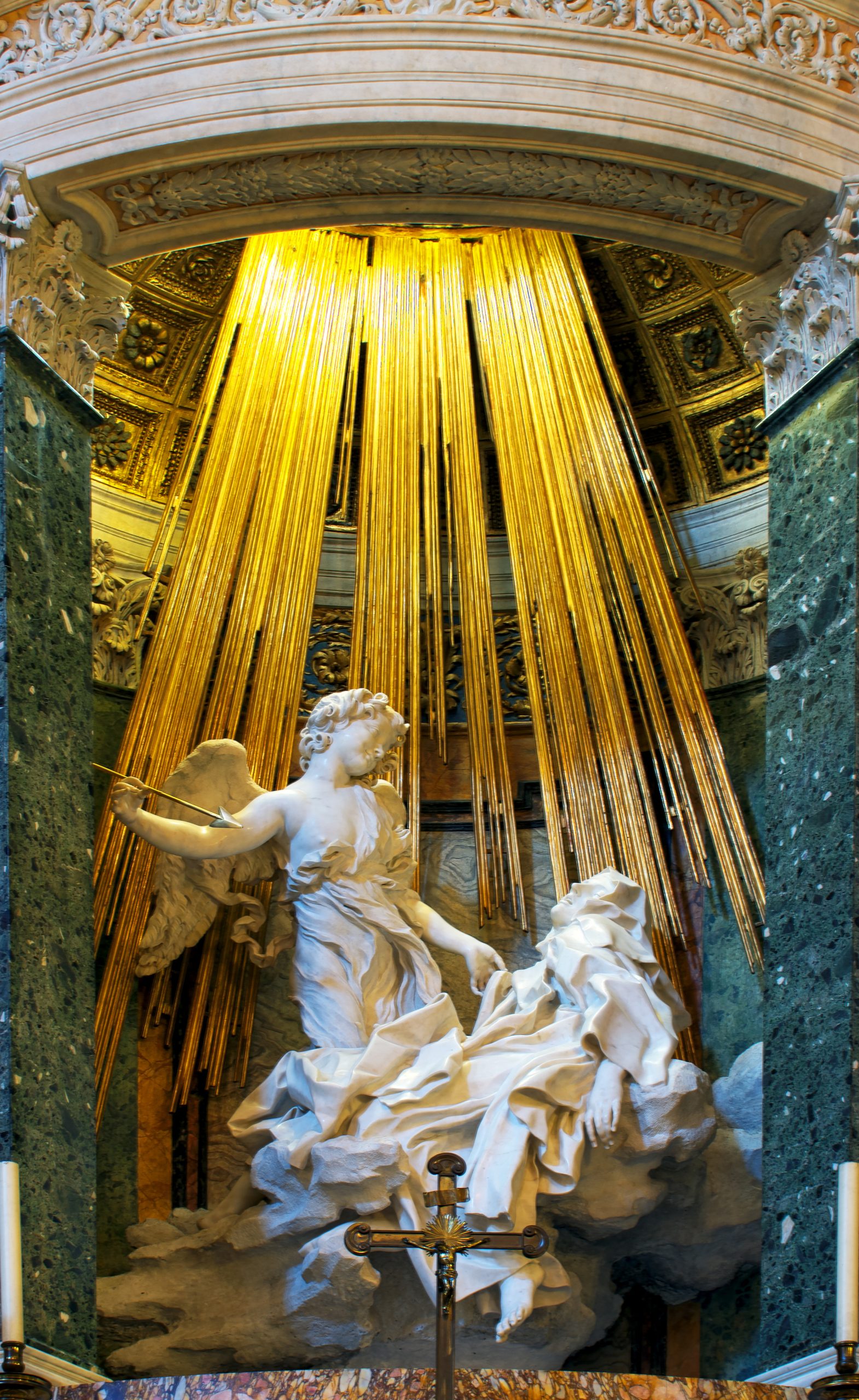
Building on these Teresian resonances, the white and gold color palette of “Sauvignon Blanc”—developed through references to pearls, porcelain, and the wine’s hue—brings to mind Gian Lorenzo Bernini’s Ecstasy of Saint Teresa (1647-1652), in which the Carrara marble female subject throws her head back in ecstasy while gilded bronze rays enter her ear. Lux’s artwork evokes the sculpture, for Rosalía appears on the album’s cover with her head tilted in the same direction, and her ear showing beneath the habit.
.png)
This visual iconography also finds a sonic dimension in the dialogue that “Sauvignon blanc” establishes with “Nada te turbe.” In Santa Teresa’s poem, the narrator affirms that “Dios no se muda” (“God does not change”). Just as in previous wordplays fin Lux—like “llanta” or “habitar”—the lyric narrator’s response of “I will listen to my God” activates a multifaceted register. In this case, polyvalence links silence to stillness, hinting at the poetic kinship between “mudar” and “mudo” or “mute.”
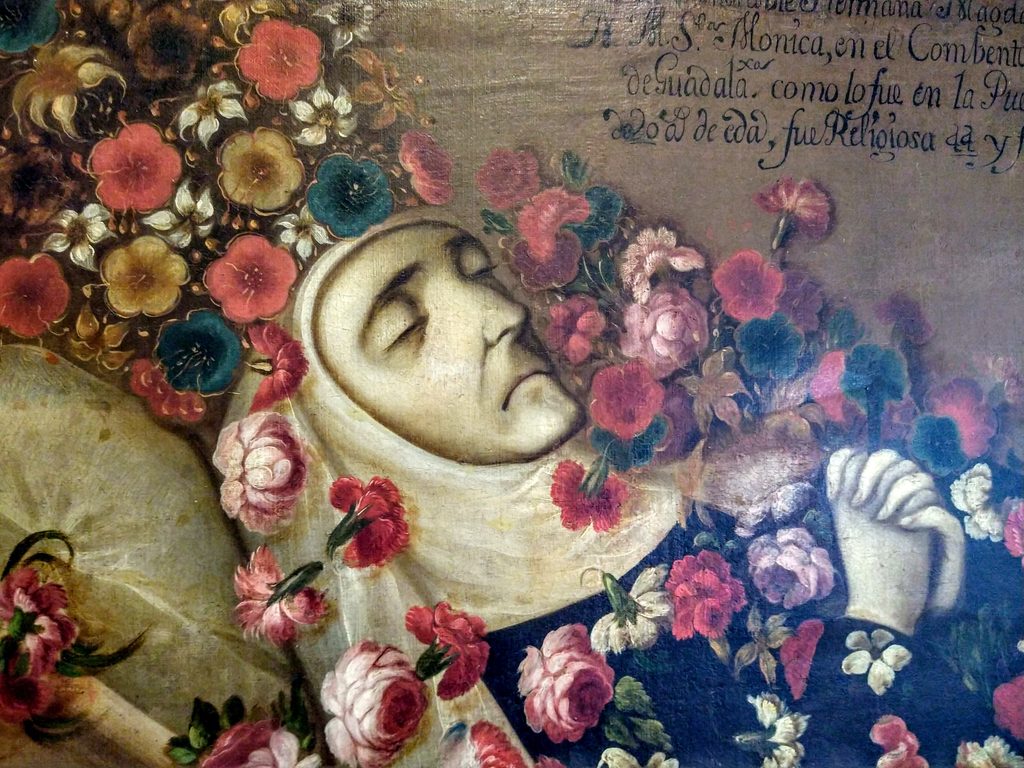
The final track, “Magnolias,” offers an intriguing reflection on death that furthers Rosalía’s dialogue with her foremothers and recalls ceremonial practices of early modern cloistered women. While “Magnolias” invokes the opulent funeral of twentieth-century Hindu mystic Anandamayi Ma, it also resonates with Hispanic tradition of crowning nuns with flowers, a topic that Alma Montero Alarcón has studied. First, at the opening of the profession ceremony, women often processed into the church dressed in opulent headdresses and accompanied by music and dance. These customs heightened the festive atmosphere and also contrasted starkly with the subsequent renunciation of earthly pleasures, especially in ascetic orders. Upon a religious woman’s death, her sisters decorated the deceased nun with flowers to symbolize her ascent to Paradise and serenaded the body with music that invoked the angel’s heavenly song as it was carried to the tomb.
The link between the two traditions is death—first, in a metaphorical sense wherein the flowers mark a religious woman’s death to the material world, and second, when she leaves her physical body. The last lines of “Magnolias” crystallize this double movement, invoking Genesis 3:19: “dust thou art, and into dust thou shalt return.” Baroque writers like Francisco de Quevedo and Sor Juana Inés de la Cruz reiterated the concept in their own reflections upon the end of human life. Rosalía dialogues with this literary tradition in “Magnolias” in a way that complements the track’s invocation of the use of flowers in cloistered nuns’ funerary rites.
The community that Lux imagines does not remain confined to the album but also spills into Rosalía’s tour, where a confessional inspired by the breakup anthem “La perla” invites female and non-binary guests to unload the secrets of their heartbreaks. In this structure, Rosalía herself replaces the traditionally male figure of the priest and absolves them. The public setting where participants share such intimacies links performers, penitents, and audience members through the age-old art of chisme (gossip) and contributes to the formation of a non-heteronormative community. The tradition also recalls the practices of early modern cloistered women. Indeed, we need look no further than Teresa of Ávila or Conceptionist nun Sor María of Agreda, who counseled the Spanish noblewomen with whom she corresponded on issues of love, motherhood, and more.
At a moment when Spanish-language women artists are reimagining the boundaries of popular music, Rosalía performs her femininity in a novel way on Lux, hearkening back to women’s spirituality from an earlier time. By echoing a diverse lineage of foremothers, she stages a woman-centered community that imagines love beyond heteronormative—or even human—confines, in a space that resonates with her female listeners.