
En Puerto Rico, la soberanía suena como el coquí / In Puerto Rico, Sovereignty Sounds Like a Coquí
https://doi.org/10.63473/WDEK6431
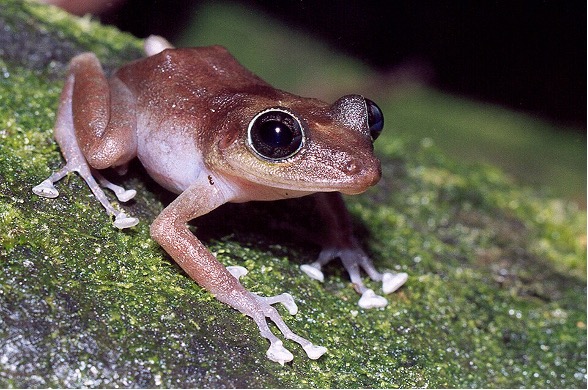
“De aquí como el coquí” es un refrán popular entre puertorriqueñes que se usa para afirmar la identidad local y sentido de pertenencia. El refrán tiene sentido porque el coquí (Eleutherodactylus coqui) es endémico del archipiélago, y su nombre es una onomatopeya del canto que los machos utilizan para atraer parejas y delimitar su territorio.
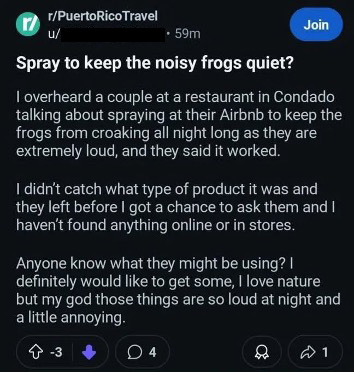
Figure 1: Screenshot of Reddit post from r/PuertoRicoTravel (username removed). Screenshot by author.
En mayo de 2025, un turista pidió sugerencias en el subreddit r/PuertoRicoTravel sobre qué productos podía rociar alrededor de su Airbnb para “evitar que las ranas (coquí) canten toda la noche [keep the (coquí) frogs from croaking all night long]” (Fig. 1). Esa pregunta en el foro de Reddit causó indignación y, al mismo tiempo, renovó el aprecio y el apoyo hacia el coquí en las redes sociales (Fig. 2).
Muches puertorriqueñes interpretaron esa pregunta tanto como un ataque a su identidad como una proyección desmedida de control de parte de un extranjero; esta reacción colectiva me hizo reflexionar sobre cómo esta controversia dialoga y amplía conversaciones académicas recientes, en las cuales se trata el concepto de soberanía sonora como un conjunto de operaciones decoloniales y plurales que entrelazan lugar, sonido, poder y cultura.
El hecho de que el coquí utilice su canto para establecer y delimitar su territorio demuestra cómo este caso destaca la conexión entre el sonido y la soberanía en el contexto puertorriqueño. El coquí ha marcado su territorio sonoramente en el archipiélago durante 29 millones de años.
El origen del post en un subreddit de turismo resaltó los problemas que ha causado esa industria en Puerto Rico desde mediados del siglo XX. En los años cuarenta y cincuenta, la Operación Manos a la Obra—cuyo objetivo era facilitar la transición de la economía local de una economía agraria a una industrial—recurrió al turismo como nueva fuente de ingresos. En sus inicios, la industria hotelera en Puerto Rico era controlada y respaldada económicamente por el gobierno, aunque compañías privadas podían manejar los hoteles. Eso fue así hasta que se construyó el Hotel San Juan Intercontinental, el cual fue el primer hotel en el archipiélago que se financió y se manejó por una empresa privada. La inauguración del Hotel San Juan en el 1958 fue un punto de inflexión en el desarrollo económico del turismo en Puerto Rico, en el que el gobierno cedió el control sobre la inversión y extracción de bienes a empresas privadas.
La corporación Intercontinental recurrió a una estrategia común de mediados del siglo XX para atraer turistas estadounidenses a su nuevo hotel. Esta estrategia utilizaba discos de LP para promover hoteles de lujo y destinos turísticos. En el 1959, la corporación contrató a Cook Records para que produjera Una Noche en el Tropicoro [A Night at the Tropicoro]. El disco, llamado igual que el nuevo club del hotel de lujo, presenta a Lito Peña y su Orquesta Panamericana. La sexta canción del álbum, un merengue en inglés llamado “Coquí,” presenta al anfibio (al que se refiere erróneamente como “rana de árbol” [tree frog]) como uno de los atractivos de unas vacaciones en Puerto Rico:
Cada anochecer,
Cuando sube la luna amarillenta
En nuestra isla caribeña,
Se oye un sonido insistente
No es un búho o un grillo
Ni es un pájaro en el pasto
Es la rana de árbol puertorriqueña
Y se escucha por doquier:
Coquí, coquí…
Emory Cook, quien fundó Cook Records, gozaba de reputación como figura innovadora en el desarrollo de equipos de grabación de alta fidelidad (hi-fi) y por sus grabaciones de paisajes sonoros tales como estaciones de tren, efectos especiales y el sonido del océano frente a la costa de Nueva York. La canción “Coquí” en el disco del Tropicoro se destaca porque lleva como introducción y conclusión una pista sonora grabada in situ, en la cual se escuchan los coquíes puertorriqueños. Esa grabación convirtió el sonido del coquí, un sonido vinculado al archipiélago, en un extracto sonoro para mercadear la “singularidad” de unas vacaciones en Puerto Rico. La grabación fue uno de los primeros medios a través de los cuales los oyentes estadounidenses llegaron a conocer el sonido del coquí, y estableció el vínculo entre su sonido y una estadía en el archipiélago.
De la misma manera que el LP transformó el coquí en un extracto sonoro de mercadeo, la industria del turismo que se ha desarrollado en Puerto Rico desde los años cincuenta transforma la cultura local en un extracto tropical para el consumo de los visitantes extranjeros, mientras elimina el control económico de las comunidades locales. Esa dinámica se discute con mayor frecuencia en Puerto Rico, donde recientemente se señala cómo la cantidad descontrolada de turistas afecta la calidad de vida de sus residentes. Las playas se privatizan para la construcción de hoteles y casas para inversionistas extranjeros; el uso del inventario de bienes raíces para alquileres a corto plazo (Airbnb, etc.) contribuye a la escasez de la vivienda y el desplazamiento de la población local; y el impacto ambiental que todo esto tiene sobre la flora y la fauna es cada vez mayor. Es en este contexto, en el cual el turista anticipa control soberano sobre el paisaje, que el coquí pasa de ser un sonido local único a ruido.
El cambio en la forma en que se percibe el sonido del coquí también señala una fricción sobre quién controla el paisaje sonoro del archipiélago, un conflicto enmarcado por el estatus de Puerto Rico como territorio estadounidense: descrito como una nueva forma de colonialismo. Le usuarie de Reddit que busca remedios para “callar al coquí” causó indignación porque esa petición va directa al centro de lo que muches puertorriqueñes se preguntan últimamente: ¿para quién es Puerto Rico? El artista puertorriqueño EFKTO respondió a esa pregunta en un video de Instagram en el cual documenta su proceso para crear su pista “El Coquí.” Lo primero que hizo fue encontrar un sample del canto del coquí que se repite a lo largo de la canción; luego declara “El coquí es de Puerto Rico so, obligao, esto hay que hacerlo en reguetón,” un género de identidad musical puertorriqueña que en el pasado también se consideraba como una molestia pública.
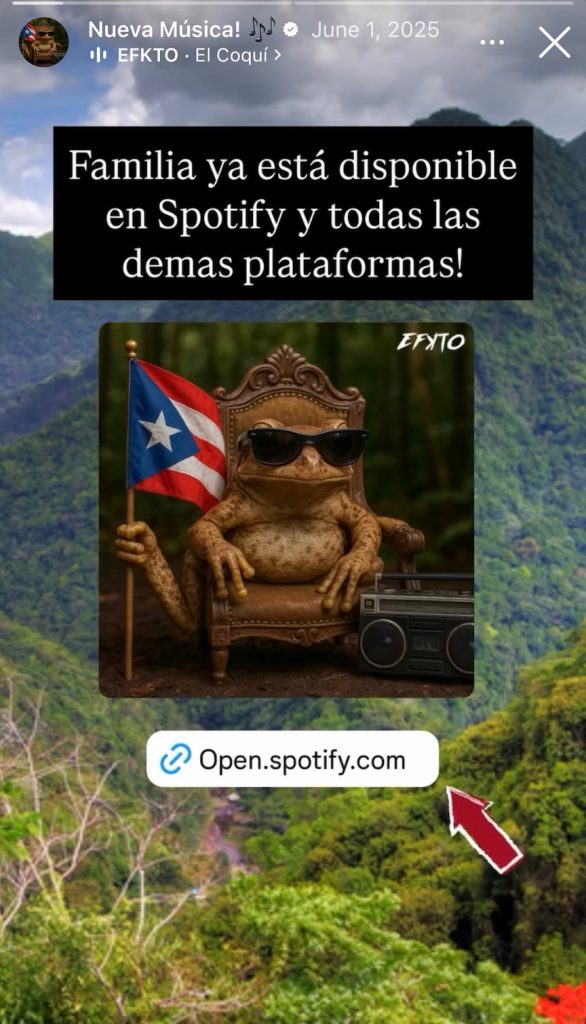
Figure 5: Screenshot of Instagram story by EFKTO announcing the release of “El Coquí” on Spotify and other streaming platforms. Posted June 1, 2025. Reproduced for scholarly analysis.
La pista final comienza con una introducción en inglés que se burla del contenido del post original en Reddit:
“Oh my god! What is that sound?
Is that the coquí frog? It’s so annoying!
I wish I could spray it with something!”
La letra de la canción sirve de testimonio de la indignación puertorriqueña ante la sugerencia del turista molesto:
Si tú estás en PR
tú vas a escuchar
al coquí cantar.
Y si no te gusta
el sonido del coquí,
pues, lárgate de aquí.
Ese sonido que tú no soportas
es el sonido de mi tierra.
Ese anfibio, aunque chiquito,
representa a mi isla Puerto Rico.
La canción actualiza la soberanía sonora porque declara claramente que el derecho a definir el paisaje sonoro de Puerto Rico le pertenece a les puertorriqueñes: si estás aquí, vas a escuchar el coquí; si no te gusta, pues lárgate. El uso continuo del si convierte a la tolerancia al canto del coquí en una precondición cultural y política de la presencia en el archipiélago. De esa manera, la canción presenta al pequeño anfibio como un aliado más-que-humano en la lucha por la soberanía cultural y política. El coquí, como representante de Puerto Rico, invierte la lógica de control: no es el turista el que decide cómo suena el archipiélago, es el sonido del archipiélago el que decide quién puede permanecer en él.
El aumento de la resistencia al turismo no es un rechazo de la hospitalidad, sino una reacción a cómo esa industria debilita la soberanía de les residentes del archipiélago y daña sus recursos naturales. Lo que quiere quien exige un paisaje sonoro libre del coquí es usurpar la agencia sonora de les residentes. Como señaló un usuarie de Reddit: “To threaten the coqui is to threaten the very soul of Puerto Rico” [Amenazar al coquí es amenazar el alma de Puerto Rico].
De aquí como el coquí [from here like the coquí (koh-KEE)] is a popular saying in Puerto Rico, a phrase often used to reaffirm Puerto Rican identity. The saying makes sense because the coquí frog (Eleutherodactylus coqui) is endemic to the archipelago, its name an onomatopoeia of the call produced by male frogs, who use it to attract mates and delimit their territory.
In a May 2025 post on the r/PuertoRicoTravel subreddit (now deleted), a user sought advice on what to spray around their Airbnb to “keep the [coquí] frogs from croaking all night long” (Fig. 1). The post swiftly sparked outrage and renewed appreciation and support for the frog on social media (Fig. 2).
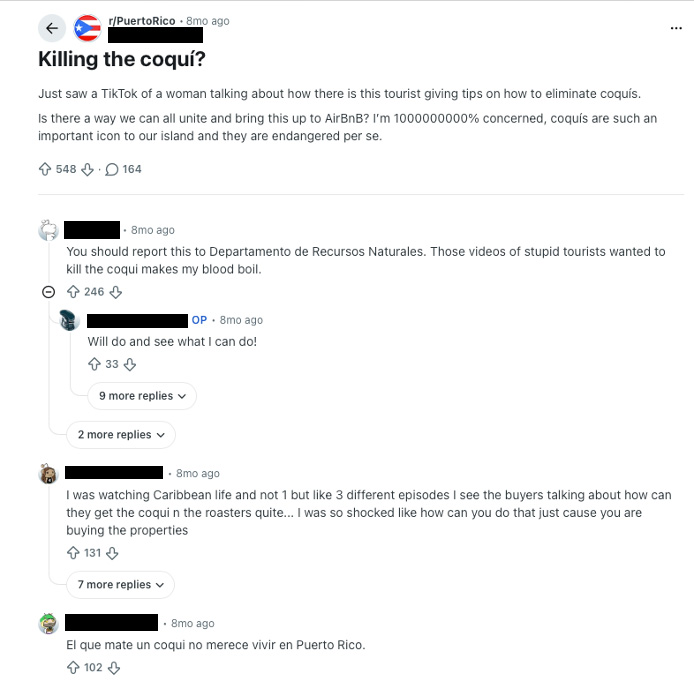
Figure 2: Screenshot of Reddit user responses discussing the coquí controversy (usernames removed). Screenshot by author.
The post was perceived by many Puerto Ricans as both an attack on their identity and an undue assertion of control over the local soundscape by an outsider; as such, it made me consider how this controversy engages and extends recent scholarship that understands sonic sovereignty as a set of plural, decolonial operations that intersect with place, sound, power, and culture.
The coquí clarifies the connection between sound and sovereignty precisely because it itself uses sound—its call—to establish and delimit its territory. The coquí has sonically asserted its territory on the archipelago for 29 million years.
The post’s origin in a tourism subreddit brought renewed attention to the tourism industry’s intersection with issues of sovereignty in Puerto Rico that go back decades. In the 1940s and 1950s, Operation Bootstrap—a government-led development program that sought to transition the Puerto Rican economy from an agrarian to an industrial economy—turned to tourism as a new source of revenue. Initially, hotels were financially backed and owned by the government although they could be operated by private companies. The San Juan Intercontinental hotel was the first hotel on the archipelago financed and owned by private enterprise; its inauguration in 1958 signaled a turning point away from local government-led development toward private foreign investment and extraction.
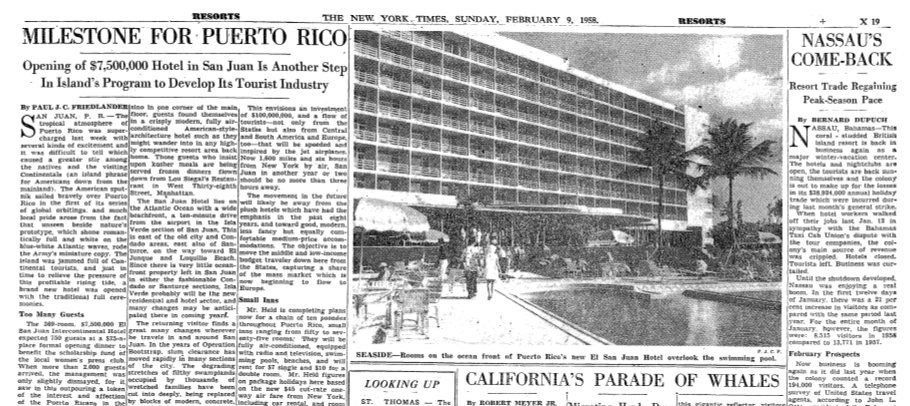
Figure 3: Announcement of the opening of the San Juan Intercontinental Hotel. New York Times, February 9, 1958, p. X19. Accessed via digital archive.
To attract U.S. tourists to Puerto Rico, The Intercontinental Corporation relied on a wider mid-century trend of using LPs to market luxury hotels and tourist destinations. In 1959, the corporation contracted Cook Records to produce A Night at the Tropicoro. Named for the hotel’s glamorous new nightclub, the LP featured Puerto Rican bandleader Lito Peña and Orchestra Panamericana; the sixth track on the album—an English-language merengue titled “Coquí”—frames the call of the amphibian (erroneously translated as “tree toad”) as one of the special features of a Puerto Rican vacation:
Every evening after sundown
As the yellow moon is rising
On our Caribbean island.
Comes a most insistent sound
Not an owl and not a cricket
Nor a songbird in the thicket,
It’s the Puerto Rican tree toad
And you hear it all around:
Coquí, coquí…
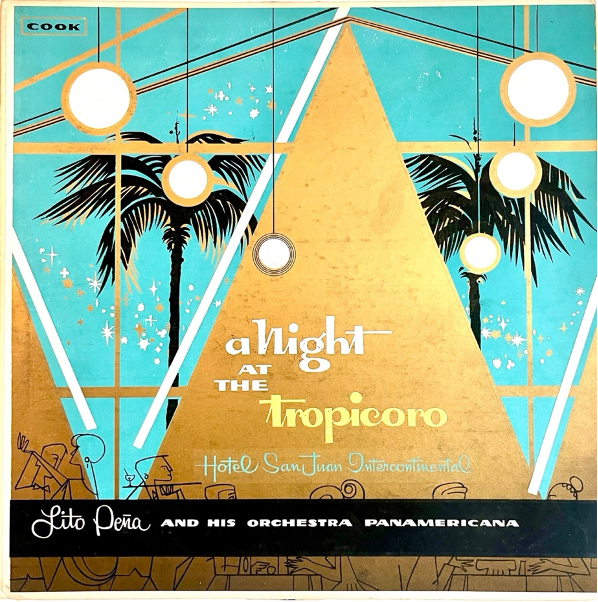
Figure 4: Cover art for A Night at the Tropicoro. Cook Records, 1959. Photograph by the author.
The founder of Cook Records, Emory Cook, had built his reputation as an innovator of high-fidelity recording equipment and for his self-made field recordings of soundscapes like train stations, sound effects, and the ocean off the New York coast. In “Coquí,” Cook bookends the musical performance with his own high-fidelity field recording of coquí frogs made in Puerto Rico; in doing so he transformed the coquí’s call—a place-based sound—into an extractable sonic fragment used to market the “uniqueness” of a Puerto Rico vacation. The track was among the earliest such recordings widely available to U.S. listeners and a key way through which many Americans first became familiar with the frog’s distinctive nocturnal call and its association with a stay on the archipelago.
Like the LP which transformed the coquí into a mediated soundbite, the tourism industry that has developed in Puerto Rico since the 1950s transforms local culture into a consumable tropical commodity while displacing economic control from local communities. This dynamic has become a recurring topic on the archipelago, with a growing number of voices arguing that the record-breaking number of tourists has gotten out of control, threatening to destroy the livelihood of the archipelago’s residents. Beaches are being taken over by private companies for new hotels and estates built for foreign investors, housing instability and population displacement are exacerbated by the growing conversion of the local supply into tourist rentals by time-share companies (Airbnb, etc.), and the archipelago’s flora and fauna bear the environmental and ecological toll. It is in this context, where tourists expect sovereign control over the landscape, that the call of the coquí has transformed from unique local sound to regulated noise.
The change in how the coquí is perceived signals friction over who controls the archipelago’s soundscape, a conflict shaped by Puerto Rico’s status as a U.S. territory described as a new form of colonialism. The Reddit user seeking advice for eliminating the coquí and “keep[ing] the frogs from croaking all night long” sparked outrage because it struck at the heart of a question many Puerto Ricans have been increasingly asking: Who is Puerto Rico for? Puerto Rican artist EFKTO addressed that question on a May 27th reel on Instagram that documents his process for creating his track called “El Coquí.” He first finds a sample online of the coquí’s call to use throughout the track; he then states, “The coquí is from Puerto Rico, so we have to make this into reggaetón,” a musical marker of contemporary Puerto Rico that once was also condemned as a nuisance.
The finished track begins with a spoken introduction in English that mockingly paraphrases the content of the Reddit post:
“Oh my god! What is that sound?
Is that the coquí frog? It’s so annoying!
I wish I could spray it with something!”
The song’s lyrics then directly sum up the outrage being expressed by Puerto Ricans in the wake of the post:
If you are in PR
you will hear
the song of the coquí.
and if you don’t like
the sound of the coquí,
then, get out of here.
That sound that you can’t stand
is the sound of my land.
That amphibian, though small,
Represents my island, Puerto Rico.
The lyrics perform sonic sovereignty by clearly articulating that the right to define the soundscape of Puerto Rico belongs to Puerto Ricans: If you’re here, you will hear the coquí, and if you don’t like it, then leave [lárgate de aquí]. The repeated use of “if” thus turns tolerance for the coquí into a political and ethical condition of presence on the archipelago. In doing so, the song positions the little amphibian as a more-than-human ally in the struggle for cultural and political sovereignty. The coquí, as representative of the archipelago, flips the logic of control: the tourist does not decide what the soundscape should be; the soundscape decides who may remain.
The growing resistance to tourism is not a rejection of hospitality, but a reaction to how tourism undermines the agency of the archipelago’s residents and accelerates harm to its ecosystem and biodiversity. What the tourist who demands a coquí-free soundscape during their stay is really after is to usurp sonic agency from the archipelago’s residents. As a Reddit user summed it up, “To threaten the coqui is to threaten the very soul of Puerto Rico.”
Este escrito se basa en un capítulo de mi libro en desarrollo sobre sonido, poder y soberanía en Puerto Rico. • This piece draws from a chapter-in-progress of my current book project on sound, power, and sovereignty in Puerto Rico.
Nota lingüística: La versión en español de este artículo utiliza morfología de género neutro (le/les, terminaciones en -e) como compromiso con la inclusión lingüística. • Language note: The Spanish version of this piece uses gender-neutral morphology (le/les, -e endings) as a commitment to linguistic inclusion.
AI disclosure: ChatGPT 5.2 was used as a proofreading and copy-editing tool for grammar and clarity. The intellectual content, analysis, and arguments are entirely the author’s Prompt: “Act strictly as a copy editor. You will work only with the prose provided. Do not generate new prose or change the prose provided. Identify genuine errors of spelling, grammar or clarity. When a problem is found, flag the error or problem and highlight it in bold: do not fix anything automatically.”